
Hello Parents, Friends, Camp Havaya Staff, and other people related to members of the Havaya Sportugbraltar trip,
It’s Sylvia (yes, I wrote all the recaps so far) back for the third time telling you everything about the trip. This one got kind of long, so feel free to scroll to the section you want to read the most, skip to the TLDR at the end, or read it all (thanks, Dad)! We start out with a quick intro, then talk about the history of Cordoba, finish Shabbat reflections, share about free time experience, and end with a Spanish section. This one is more fact recap-based; the next one will include quotes from possibly your own child, so stay tuned.
Introduction:
Here in Córdoba, Spain, if you want to fill up your water bottle rather than putting it in a hole where the water comes out like the replicators in Star Trek, you have to put some work into it. By stepping on a button in the floor, the water shoots straight up, and you have to put your finger down so your water bottle gets filled rather than the ground getting wet. This is what the Havaya Europe trip is about: dealing with the unexpected and working together to thrive. The truth is this trip is not perfect; it is hot, there are long days, and teenagers lose their stuff and their temper. But so is life, and all of us were grateful to visit Córdoba, a sunny city in Andalusia in the south of Spain.
History and Religion:
Córdoba used to be one of the major cities here in Spain, and during this part of the trip, we learned all about the city’s history. Religion is at the center of this city, from influential Jews that lived in what is now the Jewish quarter to the former mosque turned cathedral. The most famous Jewish person from Spain is inarguably the philosopher Maimonides, also known as Rambam. As your teens would say, he was locked in being one of the most prolific and influential Torah scholars of the Middle Ages. Since he was from Córdoba, we saw a lot of statues and streets named after him for his religious, philosophical, and medicinal contributions. He wasn’t the only notable Jew in the quarter, however. Last night, we stopped at a street named after Hasaday Ibn Shaprut, a 10th-century Jewish scholar and official adviser to the caliph in Córdoba. Fun fact, he is our very own Jack’s distant ancestor!
Shabbat and Spa:
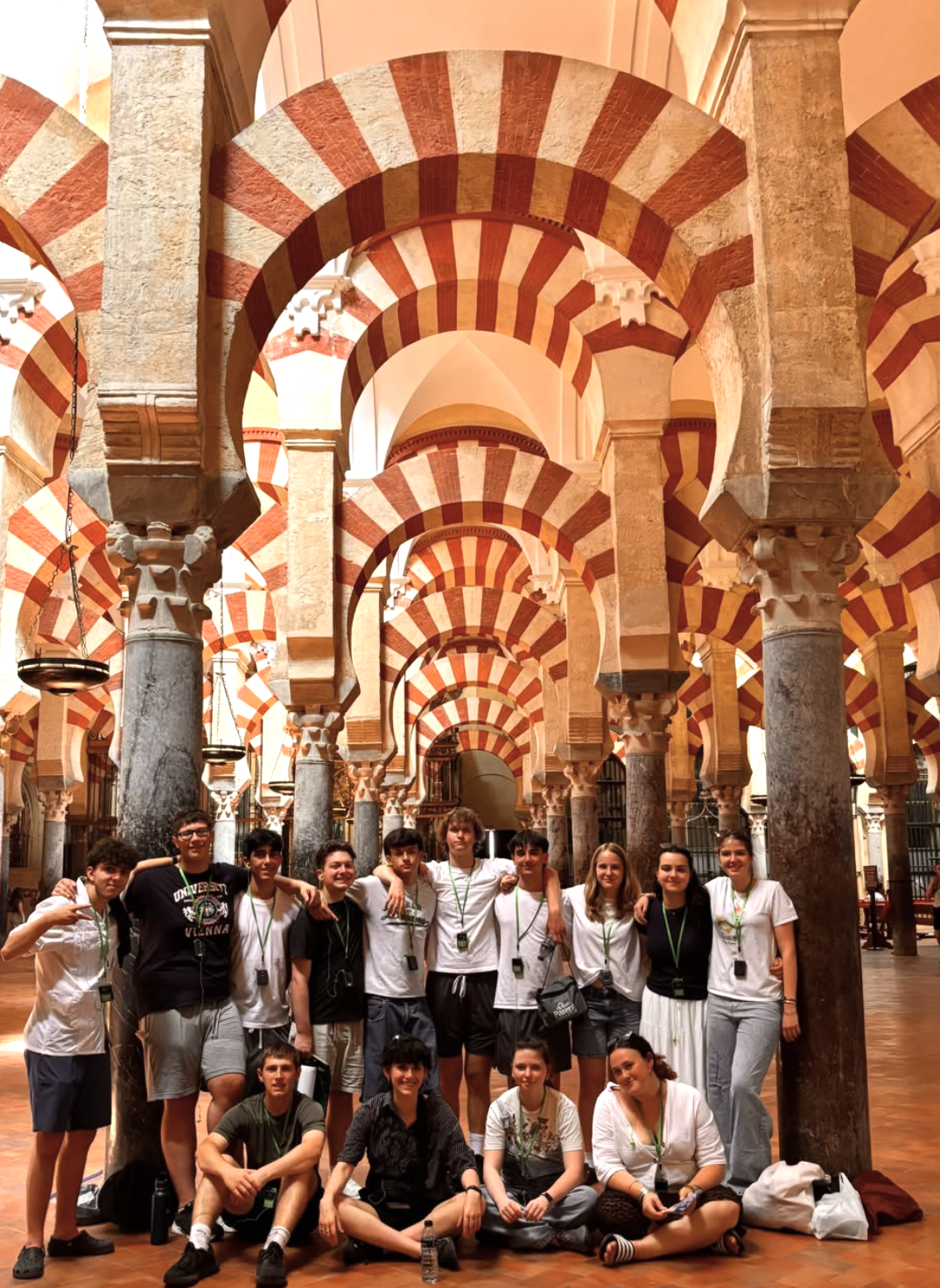
While I gave a lot of updates after Shabbat dinner, I figured that a recap of how we rested and celebrated on Saturday was proper. After a teen-led shabbat, rikkud (dancing), and shira (singing), we started our day by learning about Maimonides and Jewish life in Córdoba (we couldn’t see the synagogue sadly because of construction). Then we visited the Mezquita Cathedral, or the Mosque Cathedral, which was a former mosque turned into a cathedral. It was extremely beautiful, and our tour guide was excellent, commenting on how good our group was with engagement and asking questions. Then after lunch we got to the part we had all been waiting for: the Hamman Al-Andulas, which was a spa. We all enjoyed the free massage and the various pools because relaxation is important on a chaotic teen trip like this. I especially enjoyed the free tea that you got to drink. Overall it was a very relaxing experience that everyone enjoyed and a perfect way to cap off our Shabbat.
Pizur and Food:
Throughout the trip we have had what is called pizur time, where we go off without the group to do whatever we desire. Please don’t worry about your little Ezra or little Sarah or little insert gender-neutral Jewish-sounding name; it’s always a group of four or more, and we are required to share our location. We have had at least three rounds of pizur in Córdoba, which gave us the opportunity to buy food, treats, clothes, and even souvenir mugs for your family’s ever-expanding collection (or at least mine)! There was also a coordinated scavenger hunt around the city, which gave the members of this trip an opportunity to wander the streets of Córdoba and interact with the town. As for food, we spent most of our time in Córdoba at the Kosher Casa Mazal. Serving Sephardic Jewish fare, it was a very nice restaurant, and we appreciated them hosting all of us. Notable dishes for me included various thick soups, hearty bread rolls, apple cake, rice and veggies, and couscous with veggies. We might have broken a plate or two, but it was the perfect place to accommodate our variety of dietary needs. Other than that, ice cream and slushies were popular because of the heat.
Havaya en Espanol!
Don’t use Google translate. At least one of you is looking it up right now. I have graciously hand translated my Spanish message below!
¿Sabías que la escritora de esas noticias habla español? Si no me conoces, me llamo Sylvia y he estudiado español desde seis años en un programa de inmersión. Entonces aquí en ese párrafo voy a usar mi experiencia con el español para hablar sobre cosas interesantes españolas. Si usas Google Translate, como mi maestra decía, ¡no Google Translate! Ya escribía una letra en inglés; sus niños están tratando duramente de hablar español, pidiendo cosas y hablando con locales aunque sea difícil. Voy a terminar con hablar sobre el castellano, que es el tipo de español que se habla en España, y es porque pronuncio Andalucía como Andaluthia. Se viene de la región histórica de Castilla donde se originó. También es donde la reina Isabel I de los reinos católicos (los que expulsaron a los judíos) se gobernó. Hay diferentes palabras en castellano para describir ciertas cosas, como se usan “ciao” más que “adiós” o “móvil” en vez de “celular”. Entonces, ciao por ahora y nos vemos en la próxima edición de Havaya Sportugbraltar.
Did you know that the writer of these news reports speaks Spanish? If you don’t know me, my name is Sylvia, and I have studied Spanish since I was 6 years old in a Spanish immersion program. So here in this paragraph I am going to use my Spanish speaking experience to talk about interesting Spanish things. If you are using Google Translate, I spent 5 minutes hand translating this, so why? Your kids are trying hard to use the bits of the language they know to ask for things and talk to locals even though it is hard. I am going to end this section by talking about Caestellano, which is the type of Spanish they speak here in Spain, and it’s why Andalucia (the region we are in) is pronounced here like Andaluthia. The name comes from the historic region of Castile, where the language of Spanish originates from. It is where Queen Isabella I ruled as half of the Catholic Monarch (the ones who expelled the Jews). There are different words in Castellano to describe different things, like they use “Ciao” more than “Adios” and “Mobil” rather than “Cellular” for cell phone. So then, ciao for now, and we will hopefully see you in the next edition of the Havaya Sportugbraltal blog.
TLDR:
Córdoba is hot but fun, with lots of Jewish history and relaxing to spend Shabbat in. We got to learn all about important Jewish figures during the Muslim era, like Hasday Ibn Shaprut (who has a personal connection to our group; now do you want to read the whole thing?) and Maimonides. Everyone visited the beautiful combined mosque and cathedral and relaxed in a spa. All us teens are having fun relaxing and spending time together, so this is your trip reporter Sylvia signing out for Córdoba. See you in Granada!